
The calendar invite said ‘ops sync’ but it was really a triage session. Fourteen people on the call. Six departments represented. One agenda item that had been on the list for eleven weeks: who owns the client onboarding process?
Nobody did. Not formally. The founder had been making the call case by case. The account managers assumed operations handled it. Operations assumed account management did. Meanwhile, three new clients had received inconsistent onboarding in the past quarter, one had escalated, and the founder had spent six hours that week personally smoothing over the friction.
This is not a people problem. The team was capable. The intent was there. But the business had scaled past the point where informal coordination works – and nobody had built the formal structure to replace it.
A fractional Chief Operating Officer is the role built for exactly this stage. Not a consultant who delivers a report. Not an interim executive filling a seat. A part-time senior operations leader who diagnoses what is broken, builds what is missing, and installs the accountability structures that let a business run without every decision routing through the founder.
This guide covers what a fractional COO is, what they actually do, when a business needs one, and what it costs – with a specific lens on how operational clarity and financial clarity have to work together for either to be effective.
1. What Is a Fractional COO?

A fractional COO is an experienced operations executive who works with a business on a part-time, contract, or retainer basis. The engagement is defined – a set number of hours or days per week – but the caliber of leadership is not reduced. A fractional COO brings the same strategic and operational depth as a full-time hire at a fraction of the cost, because the business is purchasing a defined portion of their time rather than their full availability.
The fractional model has grown significantly among startups and small-to-mid-sized businesses as a practical solution to a real problem: executive-level operational leadership is necessary at a certain scale, but the cost of a full-time C-suite hire is not yet justifiable. Fractional solves that gap.
How the Fractional Model Works
Most fractional COO engagements operate under one of three structures:
- Retainer-based: A fixed monthly fee for a defined number of hours or days per week. The most common model for ongoing operational leadership.
- Project-based: Engaged to complete a specific initiative – a systems overhaul, a team restructuring, or a process audit with implementation.
- Interim: A temporary full-time engagement while a permanent COO is being recruited – time-bounded and transition-focused.
How It Differs from a Consultant or Interim COO
A consultant diagnoses and recommends. They deliver findings and exit. A fractional COO stays to implement, measure, and iterate – they own outcomes, not just advice. An interim COO fills a permanent seat temporarily. A fractional COO is a long-term operational partner whose engagement scales as the business evolves. The distinction matters because accountability is different in each model.
Who Becomes a Fractional COO?
Most fractional COOs are former full-time C-suite executives or senior operations leaders with 15 to 25 years of cross-industry experience. They bring established frameworks, pattern recognition across dozens of business challenges, and an objective outside perspective that an internally promoted operations manager rarely has. They have seen the onboarding breakdown before. They know exactly what structure fixes it.
2. What a Fractional COO Actually Does
The role is easier to understand through its outputs than its title. Here is a breakdown of what a fractional COO typically owns or directly influences:
Process Design and Optimization
A fractional COO maps existing workflows – often documenting them properly for the first time – identifies the specific steps where work stalls, and redesigns processes that can scale. This includes building Standard Operating Procedures (SOPs), selecting and configuring project management tools, and eliminating the duplicated effort that quietly accumulates when teams grow without structure. This is particularly vital in complex sectors like real estate accounting or construction bookkeeping, where project handoffs are constant
For the business in the introduction, the output of this work would be a documented client onboarding process with defined ownership, a checklist in the project management tool, and a single accountable person on each side of every handoff.
Team Structure and Accountability Systems
Growth without structure creates role ambiguity – and role ambiguity is expensive. Work gets dropped not because people are negligent, but because nobody was clearly responsible. A fractional COO redesigns org charts, clarifies reporting lines, and builds the accountability frameworks – weekly check-ins, KPI ownership, escalation paths – that ensure decisions get made at the right level without everything routing through the founder.
Cross-Department Coordination
In a five-person business, coordination happens naturally. In a twenty-person business with sales, marketing, operations, finance, and product all running separate workflows, it has to be engineered. A fractional COO builds the operating cadence – the rhythm of meetings, reporting, and communication – that keeps departments aligned without creating bureaucracy.
KPI Tracking and Performance Management
A fractional COO defines the metrics that matter for each function and builds the dashboards that surface them. This is where operational clarity and financial clarity converge. Clean bookkeeping and accurate financial reporting give the COO reliable numbers to work with. Without accurate financial records, KPI dashboards built on top of them are measuring the wrong things. The two disciplines reinforce each other.
Supporting the CEO with Strategic Execution
The most valuable output of a fractional COO engagement is a founder who is no longer the operational bottleneck. When the COO owns execution, the founder can focus on vision, relationships, fundraising, and growth. The business stops depending on one person knowing everything – which is both a scalability problem and a risk problem that most founders underestimate until they are deep inside it.
3. When a Business Actually Needs a Fractional COO
There is no single trigger. But there are patterns that appear consistently in businesses that benefit most from fractional COO engagements. The following are not theoretical warning signs – they are the operational conditions that reliably precede a business hitting a ceiling it cannot grow through:
- The founder is the operational bottleneck. Every decision – approval requests, vendor questions, process exceptions – routes through the CEO. Their calendar is the business’s constraint, and they know it, but cannot see how to change it.
- Headcount has grown but processes have not. The team doubled in 12 months. New hires spend their first three weeks figuring out how things work because nobody documented it. Onboarding is inconsistent. Role ownership is unclear.
- Projects stall at handoffs. Work gets started but not finished. Deadlines slip not because of effort but because ownership is ambiguous between departments and nobody has the authority to force resolution.
- The business is preparing for a funding round, acquisition, or major expansion. Investors and acquirers scrutinize operational infrastructure. Disorganized operations during due diligence is a valuation risk – and a dealbreaker.
- Financial reporting exists but operational decisions are not informed by it. Clean books and an accurate P&L are available, but the business is not using that data to drive operational choices around headcount, vendor costs, or process investment.
Rule of thumb: If your business is generating $1M to $20M in revenue, experiencing rapid growth, or preparing for a significant strategic event, a fractional COO engagement is worth a direct conversation.
4. The Case for a Fractional COO: What the Engagement Actually Delivers
The value proposition is straightforward: senior operational leadership without the full-time cost, equity expectations, or six-month hiring process. But the specific returns are worth naming clearly.
Executive-Level Leadership at a Defined Cost
A full-time COO at a growth-stage company in the US typically costs between $150,000 and $300,000 per year in base salary, not including benefits, equity, and bonuses. A fractional COO engagement typically runs between $3,000 and $15,000 per month – comparable strategic impact at a fraction of the total investment, with no equity dilution and no long-term employment commitment.
Fast Time-to-Impact
A full-time COO hire takes weeks to source, weeks to onboard, and months to reach full effectiveness. A fractional COO has typically seen the specific problem you are facing – the broken handoff, the accountability gap, the founder bottleneck – across multiple previous engagements. The diagnostic phase is fast because the pattern recognition is already there.
Financial Clarity Enables Operational Decisions
A fractional COO who walks into a business with clean, current financial records – accurate monthly P&Ls, reconciled accounts, reliable cash flow reporting – can make better operational decisions faster. When the books are a quarter behind and the expense categorization is inconsistent, operational planning is built on estimates. The businesses that get the most from fractional COO engagements are the ones that already have their financial foundation in order.
Scalable Engagement
The engagement scales with the business. Increase hours during a product launch, systems implementation, or growth sprint. Pull back during quieter periods. No fixed headcount, no severance exposure – just operational capacity calibrated to actual need.
The Founder Stops Being the Default Answer
This is the return that matters most to founders who have experienced it. When a fractional COO owns operational execution, the founder’s calendar opens. The decisions that should not require them stop requiring them. The business acquires the operational independence that is a prerequisite for real scale.
5. Fractional COO vs. Full-Time COO: Which Does Your Business Need?
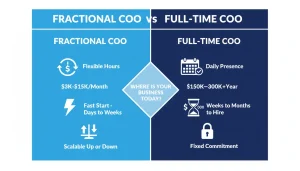
The decision is less about preference and more about where the business is in its development and what the operational complexity actually demands.
| Factor | Fractional COO | Full-Time COO |
| Cost | $3K – $15K/month | $150K – $300K+/year |
| Commitment | Flexible / Part-time | Full-time, permanent |
| Time to Start | Days to weeks | Weeks to months |
| Ideal For | Startups, SMBs scaling to $20M | Established enterprises |
| Flexibility | High – scale up or down | Low – fixed contract |
| Expertise | Cross-industry breadth | Deep company knowledge |
When Fractional Is the Right Choice
If the business is generating under $20M in annual revenue, still defining its operational model, or not yet at the scale where C-suite overhead is justified, fractional is almost always the right starting point. It delivers senior-level capability without premature fixed cost.
When Full-Time Is the Right Move
When operational complexity is constant rather than periodic, when the business requires daily executive presence embedded in culture and decision-making, and when revenue supports the investment, the transition to a full-time COO makes sense. Many businesses use a fractional engagement to lay the operational groundwork and to clearly define what they actually need from the permanent hire – which results in a better hire when they make it.
6. Fractional COO vs. Fractional CFO: Complementary, Not Competing
These two roles are frequently discussed together and often brought into a business at a similar stage of growth. They are complementary by design – but they are fundamentally different in what they own.
| Fractional COO | Fractional CFO |
| Owns operational execution | Owns financial strategy |
| Builds workflows and SOPs | Manages budgets and forecasts |
| Aligns teams and removes bottlenecks | Manages capital and cash flow |
| Drives day-to-day performance | Plans for future financial scenarios |
| Asks: How do we do this? | Asks: Can we afford this? |
How They Work Together
Think of the CFO as the person who sets the financial destination and the COO as the person who builds the road to get there. When both are functioning well, a business has financial clarity and operational discipline working in sync.
In practical terms: the CFO’s cash flow forecast tells the COO what operational investments are affordable and when. The COO’s process improvements reduce the operational costs that the CFO is tracking against the budget. Neither role works at full effectiveness without the other – and neither works without accurate underlying bookkeeping that both can trust. A business that has clean, current financial records is the foundation that makes both fractional engagements worth the investment. Managing business finances properly is a prerequisite for real scale.
Can One Person Do Both?
Rarely, and rarely well. Financial strategy and operational execution require distinct skill sets and distinct time commitments. Asking one person to own both typically results in one domain receiving insufficient attention. Most fractional executives are specialists – and businesses are better served by engaging both roles separately than by finding a generalist who covers both inadequately.
7. The First 90 Days: What a Fractional COO Engagement Looks Like
One of the most practical questions a business owner asks before engaging a fractional COO is: what actually happens after the contract is signed? Here is a realistic picture of a well-structured engagement across the first three months.
| Days 1-30: Discover | Days 31-60: Build | Days 61-90: Execute |
| Audit all operations and processes | Redesign inefficient workflows | Drive key strategic initiatives |
| Stakeholder interviews | Implement tools and software | Track KPIs and performance |
| Map gaps and bottlenecks | Clarify team roles and ownership | Report results to leadership |
| Deliver recommendations | Align cross-department communication | Refine systems for long-term scale |
Days 1-30: Discovery
The first month is diagnostic. A fractional COO who moves to action before understanding the full picture causes more disruption than they resolve. Discovery involves stakeholder interviews with founders, department heads, and key team members – listening for where friction lives, where decisions stall, and where accountability breaks down. Existing processes are audited. Documentation is reviewed, or its absence is noted. The output is a prioritized set of recommendations, not action.
Critically, this phase also includes a review of financial reporting. How current are the books? Are the monthly P&Ls accurate? Does the business have reliable cash flow visibility? The answers shape what operational investments are realistic and where the financial foundation needs strengthening before operational systems can be built on top of it.
Days 31-60: Building
With a diagnosis in hand, implementation begins. Broken workflows are redesigned. The right project management and communication tools are selected and configured – not added on top of existing chaos, but introduced with clear protocols for how they will be used. Team roles and ownership structures are clarified. The culture begins shifting toward accountability and documented execution rather than informal coordination that depends on institutional memory.
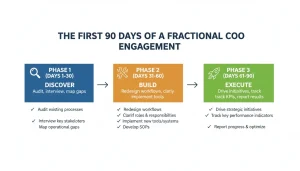
Days 61-90: Execution
The framework is in place. The third month is about driving results and proving the investment. Key initiatives are led. Performance is tracked against the KPIs established in month two. Leadership receives regular reporting – clear, structured visibility into how the business is running that does not require the founder to chase information. By the end of 90 days, the business should be operating with measurably less chaos, clearer ownership, and a structure that can absorb continued growth without fracturing.
8. How Much Does a Fractional COO Cost?
Cost is usually the first practical question and it deserves a direct answer. Fractional COO pricing varies based on experience, industry, scope of work, and time commitment. Here is a breakdown of the most common structures:
Retainer-Based Pricing
The most common model. A fixed monthly fee in exchange for a defined number of hours or days per week. Typical retainers run from $3,000 to $15,000 per month. Highly experienced COOs in specialized industries or with specific sector expertise command the higher end of that range.
Hourly Pricing
Some fractional COOs charge by the hour – typically between $150 and $400 per hour depending on experience. This model suits lighter-touch engagements or businesses that need periodic strategic input rather than ongoing operational management.
Project-Based Pricing
For a defined scope – a process overhaul, an operational audit, a systems implementation – a fractional COO may quote a flat project fee. This typically runs from $5,000 to $50,000 depending on complexity and duration.
How to Evaluate the Return
The return on a fractional COO investment is measured in concrete terms: founder hours recovered per week, revenue-generating activities unblocked, error rates reduced, headcount optimization from process efficiency. Businesses that invest in operational discipline consistently outperform peers on growth metrics – but that investment only compounds when the underlying financial infrastructure is also in order. Accurate books, current reconciliations, and reliable monthly reporting are what make the operational improvements measurable and the ROI visible.
If your financial records are not current or your bookkeeping is behind, that is the foundation to fix first. Schedule a financial health audit to see if your foundation is ready for scale Clean financials are what make every operational investment – including a fractional COO – legible and defensible.
9. Frequently Asked Questions
Can an early-stage startup afford a fractional COO?
In many cases, yes. If the founder is spending more than 30% of their time on operational tasks instead of growth and strategy, the cost of a fractional COO is frequently offset by the value unlocked. Engagements can start as small as 10 hours per month – a low enough entry point that the question is not affordability but prioritization.
How long do fractional COO engagements typically last?
Most run between 6 and 18 months. Some businesses engage a fractional COO for a specific transformation project with a defined end state. Others maintain an ongoing advisory relationship as the business continues to scale. The engagement structure evolves – what starts as 3 days per week during a systems overhaul may settle to 1 day per week for ongoing strategic oversight.
What is the difference between a fractional COO and an operations manager?
An operations manager handles day-to-day execution within a defined scope and reports into a management structure. A fractional COO sets the operational strategy, designs the systems that the operations manager works within, and operates at the executive level – making decisions about structure, process, and organizational design that an operations manager does not have the mandate or seniority to make.
Can a fractional COO work remotely?
The majority of fractional COO engagements today are remote or hybrid. Most fractional executives are experienced leading distributed teams using the same collaboration tools modern businesses rely on – Slack, Notion, Asana, Monday.com. The occasional in-person session during the discovery phase and at key decision points is valuable but not a prerequisite for effective engagement.
When should a business transition from fractional to a full-time COO?
When annual revenue exceeds $20M to $30M, when operational complexity demands daily executive presence, or when a major institutional event – an acquisition, an IPO – requires a permanently embedded executive. Many businesses use their fractional COO to write the job description and evaluate candidates for the permanent role, which results in a better hire and a smoother transition.
How is a fractional COO different from a business consultant?
A consultant delivers recommendations and exits. A fractional COO stays to implement, measure, and iterate. The difference is accountability – a consultant owns the quality of the advice, a fractional COO owns the outcomes.
10. Operational Clarity Is a Growth Strategy
The eleven-week meeting agenda item about client onboarding ownership gets resolved in the first month of a fractional COO engagement. Not because the COO has a magic answer, but because they have seen this exact pattern across enough businesses to know what the fix looks like – and they have the mandate and the methodology to implement it without needing consensus from fourteen people on a call.
Growth without operational infrastructure is fragile. The businesses that scale successfully are not always the ones with the best product or the most aggressive sales motion. They are the ones that build the systems, processes, and accountability structures that achieve operational excellence.
A fractional COO is one of the most cost-effective ways to build that infrastructure – particularly when paired with clean financial reporting that makes every operational decision legible. The two disciplines are not separate investments. They are the same investment in two dimensions: knowing what is happening operationally, and knowing what it is costing financially.
If you are a founder who recognizes the operational patterns described in this guide, the conversation worth having is not whether you need a fractional COO. It is whether your financial foundation is strong enough to make the engagement fully effective from day one.
Ready to build the financial foundation your operations depend on? Our bookkeeping and accounting services give scaling businesses the clean, current financial records that make every operational investment legible and every growth decision defensible.
